
Cybersecurity Awareness Explained: Why It Matters More Than Ever in 2026
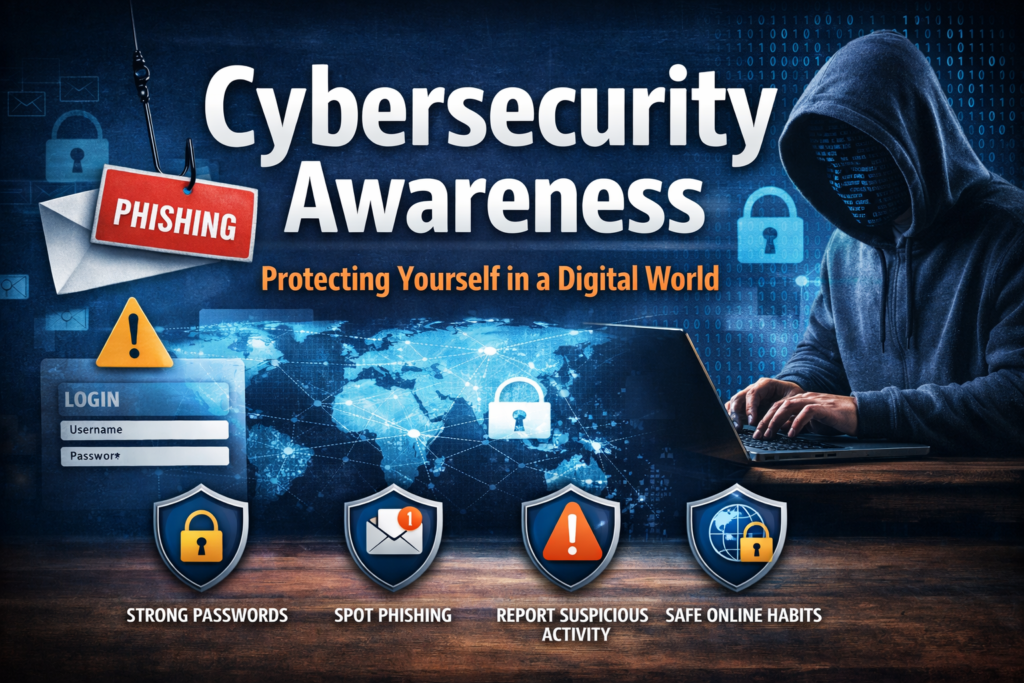
Cybersecurity awareness is no longer just an IT issue. It has become a global business and personal safety issue because many cyberattacks still start with a human mistake: clicking a phishing link, reusing a weak password, approving a fake login request, or trusting the wrong message at the wrong time.
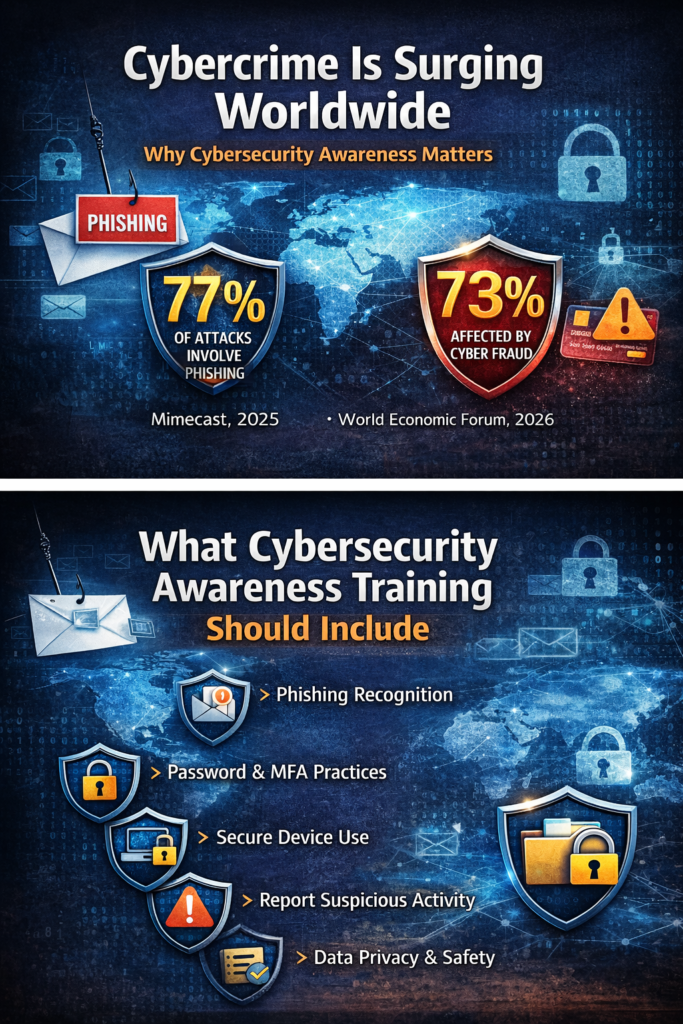
That matters even more now because cyber threats are growing in scale and sophistication across the world. The World Economic Forum reported in 2026 that 77% of respondents saw an increase in cyber-enabled fraud and phishing, while 73% said they or someone in their network had been personally affected by cyber-enabled fraud.
This is the real reason cybersecurity awareness matters. Attackers are not only targeting systems. They are targeting people.
What is cybersecurity awareness?
Cybersecurity awareness means teaching people how to recognize, avoid, and report common digital threats. That includes phishing emails, smishing, malicious links, password reuse, unsafe downloads, suspicious login requests, and poor data-handling habits.
A lot of weak content treats awareness as a yearly compliance exercise. That is outdated. Modern awareness training is about improving day-to-day behavior, not forcing employees to sit through generic slides once a year.
This shift matters because human risk is still central to cyber defense. Proofpoint reported in 2025 that 66% of CISOs identified people as their biggest cybersecurity vulnerability, showing that awareness is still one of the most important security layers in any organization.
Why cybersecurity awareness matters now
The biggest reason is simple: phishing and social engineering still work.
Mimecast reported in late 2025 that phishing accounted for 77% of all attacks, up from 60% in 2024. Proofpoint also found that malicious URLs are a major delivery method, with URLs used four times more often than attachments in malicious emails.
That is a major warning sign. Attackers do not always need advanced exploits when human behavior gives them a much easier route in.
There is also a second problem: AI is making attacks more convincing. The World Economic Forum’s 2026 outlook highlights AI adoption and cyber readiness as a major global issue, while Fortinet’s global research found that 49% of respondents were concerned AI would increase cyberattacks.
So the modern challenge is not just volume. It is believability. Messages are getting harder to spot, and awareness training has to adapt to that reality.
The rise of companies like Anduril also shows how cybersecurity, surveillance, and autonomous defense systems are becoming more connected.
Check out our full Anduril startup breakdown : https://limitedtime.co/anduril-startup-2026/
What good cybersecurity awareness training includes
A strong cybersecurity awareness program should focus on behavior, repetition, and relevance.
That means training people to:
- spot phishing and fake login pages
- handle passwords and multi-factor authentication properly
- protect devices and accounts
- avoid risky links and downloads
- report suspicious activity quickly
- understand basic data privacy and secure communication habits
Fortinet’s 2026 global awareness report found that 67% of organizations reported moderate or significant reductions in intrusions, incidents, and breaches after implementing awareness and training. That is the kind of result that makes this more than a compliance topic. It becomes a measurable risk-reduction tool.
The best programs also avoid one common mistake: being too technical. If the training does not reflect how people actually work, it will not stick.
Common cybersecurity awareness mistakes
One of the biggest mistakes is thinking awareness means fear-based messaging. That usually creates fatigue, not better judgment.
Another is relying on one annual training session and assuming the problem is solved. Threats evolve too quickly for that. The data points the other way: repeated training, realistic simulations, and ongoing reinforcement work better than one-off content.
The third mistake is blaming users without improving systems. Awareness works best when it is paired with clear reporting processes, simple guidance, strong authentication, and tools that reduce the chance of human error.
Final thoughts
Cybersecurity awareness matters because human behavior remains one of the most targeted and most exploitable parts of digital security. Around the world, phishing, fraud, malicious links, and AI-assisted social engineering continue to grow, which makes awareness training more important, not less.
The best awareness programs do not just tell people to be careful. They teach habits that reduce risk in real situations. And that is what makes cybersecurity awareness valuable at a global level.
.